Pre-Authorized Payment
Definition
A pre-authorized payment is a type of hold that checks if the card number is valid and if the customer's account has sufficient funds. However, this pre-authorization does not settle the charge or transfer funds. Merchants may use this for a number of reasons, including delayed fulfillment of the product, varying final costs, or a service deposit.
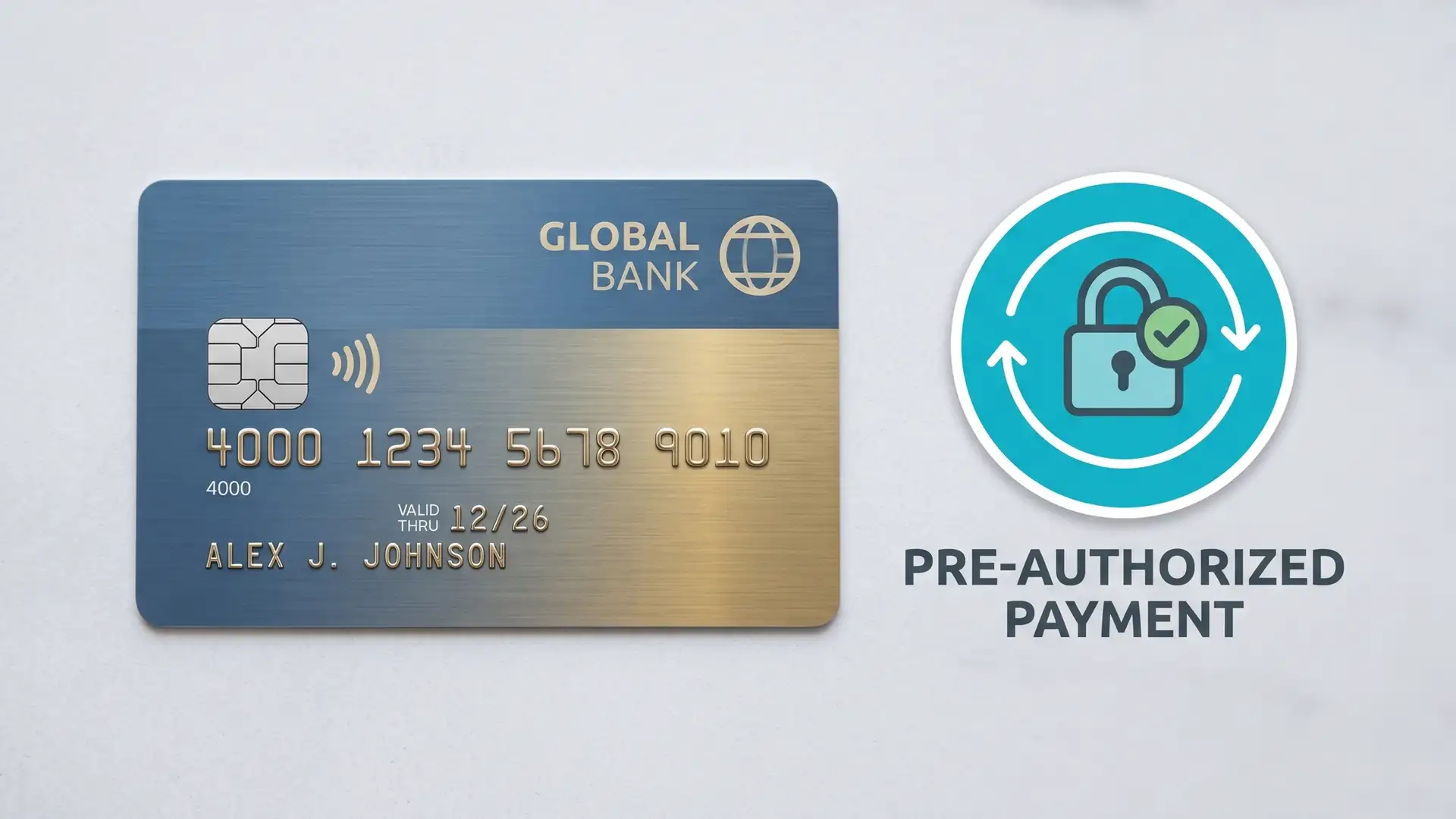
A credit card and an icon that represents a pre-authorized payment
Credit: Adaptiv Payments
On this page
- What Is a Pre-Authorized Payment?
- Pre-Authorization Charges vs Capture vs Refund
- How Pre-Authorized Payments Work
- Timing Windows and Why Pre-Authorizations Expire
- When Merchants Should Use Pre-Authorization (And When They Shouldn’t)
- Partial Capture, Incremental Authorization, and Reversals
- Customer Experience: Why People Think Pre-authorization Is a “Double Charge”
- Risk and Disputes: How Pre-Auth Reduces Risk and When It Backfires
- Pre-authorization in Common Use Cases
- Implementing Pre-Authorized Payments Without Triggering Holds or Disputes: Operational Efficiency Checklist
- FAQs
What Is a Pre-Authorized Payment?
A pre-authorized payment holds funds without actually charging the customer, ensuring that the cardholder's account has enough funds to cover the final bill.
Gas stations often use temporary holds because the actual charge is not known until the customer finishes pumping. The pre-authorization transaction ensures that the credit or debit card has the necessary funds for the expected charge, and the unused funds are released shortly after.
Travel agencies and hotels often use a pre-authorized payment agreement to hold funds in case there are issues with the rental car or hotel, like damage to the vehicle. Pre-authorized transactions are also used for recurring payments like gym memberships or automatic payments like mortgage payments.
Pre-Authorization Charges vs Capture vs Refund
| What happens | What the customer sees | Why merchants use it | |
|---|---|---|---|
| Pre-Authorization | Funds are reserved pending authorization | Pending charge | Ensure fund availability for the final transaction amount |
| Capture | Funds are collected | Posted charge | Secure funds to pay for the final charge |
| Refund | Funds are recaptured by the card issuer | Reversed charge | Improve customer satisfaction by offering a refund |
How Pre-Authorized Payments Work
Pre-authorized payments ensure a smooth customer experience by reducing the number of declined transactions. These are the primary steps:
- Customer submits a payment, and the process begins.
- The issuer checks the cardholder's credit limit or account balance and approves or declines the authorization.
- The temporary hold appears as "pending."
- Once the transaction has been confirmed, the merchant captures the full or partial payment.
- The charge is settled, and the merchant is paid.
A pre-authorized payment does not guarantee a payment capture. This is especially common for pre-authorized debit holds, because there may be insufficient funds by the time the transaction is settled. Other common issues are expired holds or problems with the card issuer. Using a high-risk payment gateway with pre-authorization transaction expertise can help, though authorizations can still fail.
Timing Windows and Why Pre-Authorizations Expire
Holds only last for a few business days, though the timing depends on issuer policies, network standards, and merchant captures. Some payment methods allow longer periods than others.
If you try to capture the payment after the pre-authorization has expired, the capture may fail because there is not enough available credit or the balance is too low. The customer may need to reauthorize the payment, which can cause confusion.
Pre-authorized payments can also trigger disputes, especially if there is a long time between the hold and the final settlement or the payment and the shipping. Customers may forget that they ordered something and try to stop payment.
In other cases, the customer's available balance may be too low, and they do not want to incur overdraft fees. If the final charges differ from the withdrawal request, customers might believe they were double-charged.
To avoid these issues, define your capture timing rules by product type, such as travel, ecommerce, and services. Explain how long a hold affects a customer's account and when they can expect settlement. For example, if you include potential late fees in your preauthorization hold, outline that for customers ahead of time.
Avoid long wait times without first communicating with the customer, and explain any extra costs beyond the preauthorization hold. Explaining your process not only improves the payment experience but also helps customers with their financial planning, which builds trust.
When Merchants Should Use Pre-Authorization (And When They Shouldn’t)
Consider using pre-authorized payment structures in these use cases:
- Delayed Fulfillment: This is common for travel, made-to-order products, or products on backorder.
- Changing Final Amount: If incidentals, tips, or add-ons are common, you can incorporate this into a pre-authorization and refund fees that were not used.
- Reservations: If you need to reserve rooms, cars, or appointment times, then a pre-authorization avoids last-minute cancellations that damage your workflow.
- High-Ticket Orders: Pre-authorization charges help prevent fraud for high-ticket orders while you verify the payment information.
You should avoid pre-authorized transactions in these instances:
- Instant Digital Delivery: Ebooks, mobile games, or software purchases with instant delivery do not typically need preauthorization.
- Concerns About Reliable Capture: In some cases, it may be difficult to complete the transaction, making it more valuable to charge immediately and give a partial refund.
- Unclear Messaging or Policies: Your customer policies should be clear and unambiguous to avoid disputes.
- Frequent Partial Cancels or Changes: If balances change significantly, or customers tend to adjust their orders, a pre-authorization transaction may lead to more disputes.
Partial Capture, Incremental Authorization, and Reversals
There are different forms of pre-authorization transactions, which may work best for your specific needs.
- Partial Capture: You capture less than the authorized amount, such as for deposits on services.
- Incremental Authorization: This form increases the authorized amount when totals change, such as travel incidentals that are charged to the hotel room over time.
- Reversals and Voided Captures: You may place a hold and then release it when you won't capture. This is sometimes used for rentals.
Customer Experience: Why People Think Pre-authorization Is a “Double Charge”
Pre-authorized transactions may lead to disputes because the pending hold looks like a posted charge on an account statement, while the actual capture creates a second line item. It's crucial to communicate clearly about what a pre-authorized payment is to avoid disputes or support tickets.
To avoid disputes or chargebacks, follow these best practices:
- Label the pre-authorization payment as an "authorization hold" at checkout and on receipts.
- State the hold amount and when it will be captured or released.
- Provide receipts that clearly separate "authorized" and "captured."
- Train your support team on how to explain holds to customers.
Risk and Disputes: How Pre-Auth Reduces Risk and When It Backfires
Pre-authorized payments are not a one-size-fits-all solution. In some cases, they may reduce fraud or decline rates, while in other cases, they lead to more disputes.
Pre-authorization can be a valuable tool for confirming the card's validity and available funds before initiating a full charge. If you choose the right hold amount, you can reduce late-stage "card declined" issues, especially if your products have long lead times. Lastly, pre-authorized payments can help merchants manage variable totals or deposits.
However, pre-authorizations can lead to disputes if the hold expires before the final charge and you must re-authorize the charge. Customers may also assume they have been double-charged and initiate a dispute.
While pre-authorization can prevent fraud disputes, you may still have disputes due to service issues, refund problems, or customer dissatisfaction. Adaptiv Payments provides a full suite of tools for fraud protection and chargeback mitigation that help reduce disputes.
Pre-authorization in Common Use Cases
Travel
Travel merchant accounts use pre-authorizations to hold deposits on rooms or protect themselves against last-minute cancellations. As customers often book months in advance, travel agents must have clear policies and carefully document their authorizations.
Car Rental Services
Incremental authorizations are valuable for car rentals, as the final total may vary from the original amount. Car rentals also use pre-authorized payments to cover vehicle damage.
Delayed Fulfillment Ecommerce
With an ecommerce merchant account, pre-authorized payments can be valuable for high-ticket items or products on backorder. Merchants should pay close attention to capture timing rules and provide clear proof of delivery.
Implementing Pre-Authorized Payments Without Triggering Holds or Disputes: Operational Efficiency Checklist
Pre-authorization payments can be an invaluable way to manage cash flow, but they may also lead to disputes if not managed carefully. Follow these rules to ensure steady payments and customer satisfaction.
- Determine when to pre-authorize and when to capture immediately.
- Set capture timing rules based on your workflows.
- Define re-authorization logic if holds expire.
- Label holds clearly at checkout and in emails.
- Align your refund and cancellation policy with capture timing.
- Implement fraud screening for high-risk orders, like big-ticket items.
- Ensure workflows prioritize proof of fulfillment.
- Monitor disputes weekly and adjust rules based on data.
- Train customer support scripts to explain pending versus posted.
Adaptiv Payments' high-risk merchant account and payment gateway support seamless pre-authorizations, along with fraud protection, chargeback mitigation, and global payment processing. If you're ready to get started, contact us for a free quote.
FAQs
This means that the merchant has placed a hold on your current balance but has not settled the transaction yet.
See also
About the Author


Account Executive at Adaptiv Payments
Max Brasseaux is an Account Executive at Adaptiv Payments, where he specializes in helping businesses secure reliable payment processing solutions—especially in high-risk industries like eCommerce, travel, and nutraceuticals. He works closely with merchants to navigate underwriting, reduce processing friction, and build long-term, scalable payment setups. Max is focused on delivering transparent guidance and tailored solutions that keep businesses running smoothly without disruption.
Reviewed by Luke Deviney— Tech Lead at Adaptiv Payments·Last updated