AVS Mismatch
Definition
An AVS (Address Verification System) mismatch occurs when the billing address a customer enters during a card transaction doesn't match the address on file with the card-issuing bank. This can trigger fraud flags and increase transaction fees, or cause declines, depending on the merchant's processor settings and risk thresholds.
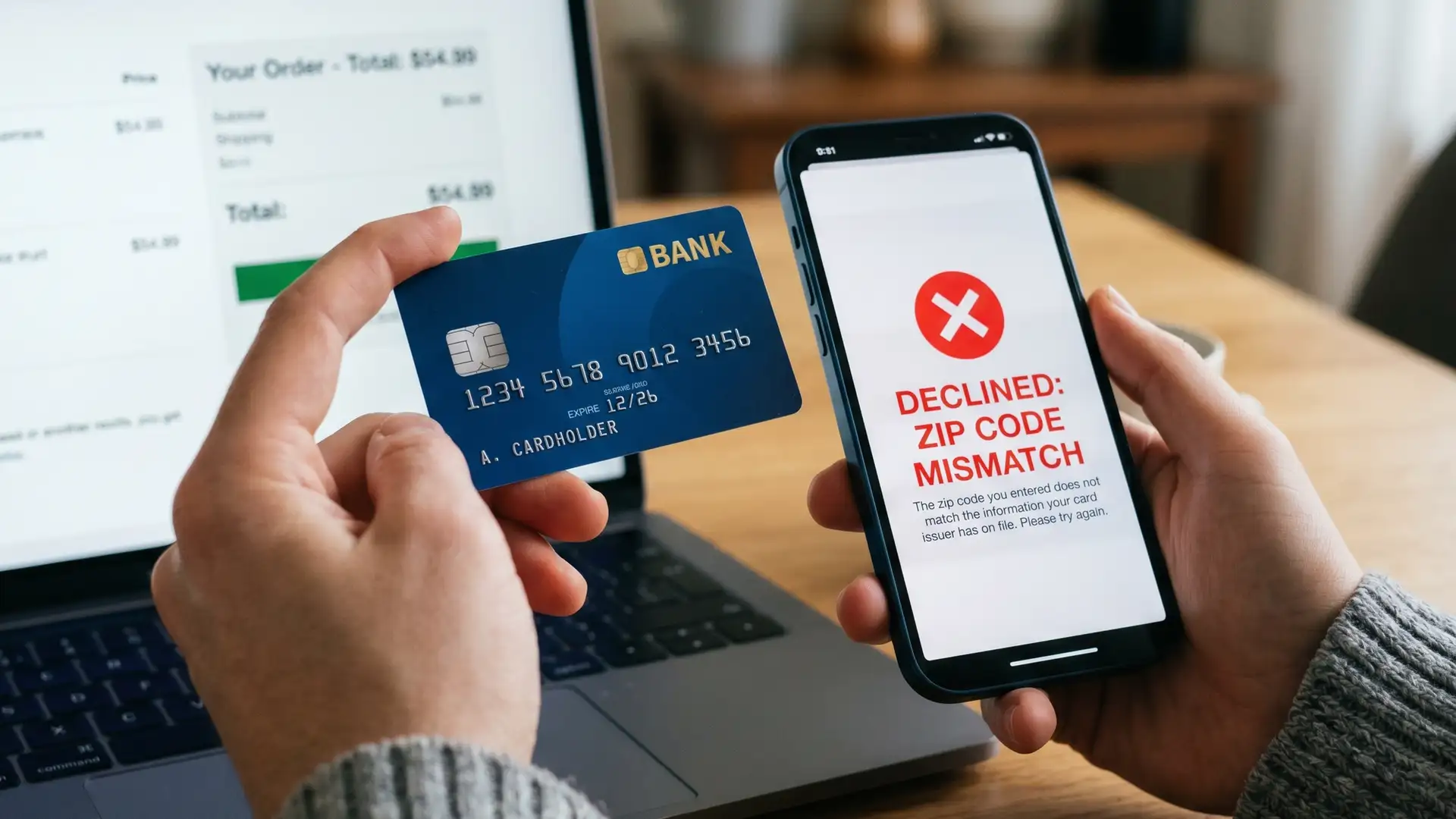
A person holding a credit card and their phone, with an avs mismatch error on the screen
Credit: Adaptiv Payments
On this page
- What Is AVS (Address Verification System)?
- What Does “AVS Mismatch” Mean?
- AVS Mismatch Codes
- How an AVS Mismatch Occurs
- How Processors and Gateways Use AVS in Risk Decisions
- When an AVS Rejection Doesn’t Mean Fraud
- AVS Settings & Practical Fixes to Reduce False Declines and Fraud
- AVS Checks in High-Risk Industries
- AVS Filters and Settings for High-Risk Merchant Accounts
An Address Verification System (AVS) is a fraud protection tool that compares the billing address provided at checkout with the credit card company's records. This is essential for card-not-present transactions, especially in high-risk categories where fraud rules are stricter.
AVS mismatch errors can occur for legitimate transactions, but they increase the risk of fraud, declined transactions, and cart abandonment.
What Is AVS (Address Verification System)?
In most cases, AVS systems check for numeric street addresses and postal or ZIP code matches with what the credit card issuer has recorded. The system does not consider the shipping address as legitimate customers may send purchases to friends.
The process involves the high-risk payment gateway or payment processor sending the customer's billing address to the card issuer. If the billing address matches, then the transaction can complete as normal, but if there are AVS errors, then the system may require a challenge or decline the transaction.
What Does “AVS Mismatch” Mean?
An AVS mismatch means that the issuer could not match the address details to what they have on file, such as what is printed on the customer's credit card statement. There are many reasons this may happen, including:
- Typo in the billing address entered
- Formatting issues, such as "Boulevard" versus "Blvd"
- Stale issuer file (issuer hasn't updated after a change of address)
- International limitations, such as different postal code formats
- Credit card fraud
AVS Mismatch Codes
While there are numerous AVS codes, they can be sorted into general categories.
- Full AVS Match: All AVS data matches, and the process can proceed.
- Partial AVS Match: The billing address and ZIP code do not match what is on file.
- No Match: None of the provided information matches the information on file.
- Not Supported: The system does not support AVS, or the billing address is not in a format that the AVS system supports.
- Unavailable: The AVS system is currently unavailable.
AVS Match vs Partial Match
A full match means the address and ZIP code match exactly with the card issuer, and the transaction can proceed as normal. However, partial AVS mismatches occur due to the street address or ZIP code not matching what the issuer has.
These mismatches may be due to different abbreviations for street names or addresses that have both letters and numbers, such as "Unit 4" for an apartment instead of "#4."
AVS Mismatch Error Codes
These are the common AVS response codes, though some processors will use slightly different ones.
Y: Full address match.
While AVS handling does not automatically prevent fraudulent transactions, the AVS has been successful, and you can use other data points to verify.
A: Partial match. Address matches, but the ZIP code does not.
You may need to adjust AVS settings to accept partial matches or use a ZIP code plugin to provide the full 9-digit ZIP code.
Z: Partial match. ZIP code matches, but street does not.
Prompt the user to check the address for common issues like the incorrect address number or the wrong abbreviation ("Str" versus "St" or "Bvld" instead of "Blvd").
N: No match.
While this may be a legitimate sale, it may also be fraudulent; prompt the user to double-check the address and issue 3D Secure challenges.
U: Card issuer does not use address verification.
You may need to disable AVS and use other fraud prevention tools to process the transaction, such as two-factor authentication.
G: The international card issuer does not use address verification.
If you regularly process international transactions and your AVS controls often return "G," you will need to bypass AVS and use alternate verification tools.
R: System timeout
The AVS transaction failed; ask the customer to refresh and try again.
O: No response sent
As the issuer did not respond, you may need to decline the transaction or implement additional security measures to verify it.
How an AVS Mismatch Occurs
While modern payment processors use robust fraud filters that can fix AVS mismatches, there are still issues that can result in these error codes, including:
- Formatting Differences: "Apt" versus "Unit," misspelled abbreviations, or using punctuation in addresses can cause issues.
- International Address Differences: Other countries may use different postal codes, and some international issuers do not use AVS.
- Billing vs. Shipping: A customer sending a gift may accidentally switch the billing and shipping addresses, or the system may capture the wrong data.
- Old Address: The customer may not have updated their billing address with the issuer.
- Corporate Cards and Issuing Bank Issues: Corporate cards often have a different billing address than the headquarters, leading to issues.
- Autofill Errors and Mobile Checkout: The autofill address may not match the issuer's information, while mobile checkout may result in timeouts.
How Processors and Gateways Use AVS in Risk Decisions
AVS is one signal used in a broader fraud protection model that includes CVV, device and IP information, transaction velocity, and 3D Secure. As part of this infrastructure, an AVS mismatch can trigger approval and decline rules. This could be a declined transaction, a soft flag that causes additional monitoring on the account, or a step-up that requires additional security questions.
High-risk MCC codes often have stricter AVS rules because of the higher risk of fraud or chargebacks, which means you may not be able to adjust your AVS match settings.
When an AVS Rejection Doesn’t Mean Fraud
An AVS mismatch error can be a simple mistake. For example, the person may have moved recently and forgotten to update their address, or the system may have flagged it because the shipping and billing addresses are different.
International customers and corporate cards often have AVS issues, either because the issuer does not use the system or because a corporate billing address is different than the customer's home address.
AVS Settings & Practical Fixes to Reduce False Declines and Fraud
Checkout UI Fixes
You can stop AVS mismatches at the course by developing a better checkout form. Have a clear "billing address" label and disable autofill fields that may incorrectly populate forms. Prompt customers to input the address exactly as it is shown on their card statement.
You can also use plugins to validate or autocomplete addresses based on the US Postal Service or international postal service data.
Address Data Normalization and Formatting Best Practices
Standardize your abbreviations, unit fields, and ZIP or postal formatting. For example, have a specific box for apartment numbers so that they are the same for each customer.
Handle non-Latin characters carefully for international addresses. You may need to use Unicode for these addresses, as non-Latin characters do not use ASCII.
AVS Response Code Rule Tuning and Thresholds
Risk-based decisioning can address AVS mismatches based on the customer's profile.
An AVS mismatch but a CVV match for a repeat customer could be allowed with monitoring to ensure the transaction is legitimate.
If the AVS and CVV do not match for a high-value transaction, you can implement step-up challenges like 3D Secure or use a manual review.
Not every international issuer uses AVS, meaning you can rely on other signals, like two-factor authentication, to approve the transaction.
A processor's rules will vary by your vertical and the processor's risk tolerance. You should ask about their procedures for mismatches to ensure you don't have high false declines.
AVS Checks in High-Risk Industries
Subscription merchant accounts often deal with friendly fraud, meaning that the customer starts a chargeback because they forgot to cancel their subscription or were not able to budget. Have a clear cancellation policy. Use AVS with clear product descriptors on subscription invoices, and send reminders before autobill so customers have time to cancel.
The travel industry often has high average order values and cross-border transactions. Step-up challenges can verify a transaction, but must be used selectively to avoid high cart abandonment.
CBD merchant accounts are subject to heightened policy scrutiny due to regulatory challenges and the high risk of fraud. AVS checks can prevent fraud without breaking conversion rates, but merchants should be especially aware of mismatches between shipping and billing addresses, as users may try to avoid local regulations by shipping elsewhere.
Lastly, ecommerce merchant accounts may sell both high-ticket and low-ticket items. Having customizable rules and step-ups depending on ticket value can reduce friction and improve conversion rates while still protecting you from fraud.
AVS Filters and Settings for High-Risk Merchant Accounts
Adaptiv Payments provides customizable merchant accounts for high-risk businesses, including AVS and fraud protection. We'll help you develop the perfect AVS filters and security measures that keep you and your customers safe while boosting conversion rates. If you're ready to get started with a personalized merchant account, robust fraud prevention, and seamless online payment processing, contact us for more details.
About the Author


Director of Sales at Adaptiv Payments
Paul Smith is a payments expert with over a decade of experience underwriting, procuring, and advancing the payments industry. Having been on-the-ground in the past getting high-risk merchants approved, he has invaluable payment industry knowledge.
Reviewed by Timmy Boyko— Account Executive at Adaptiv Payments·Last updated