How to Start an Online Supplement Store
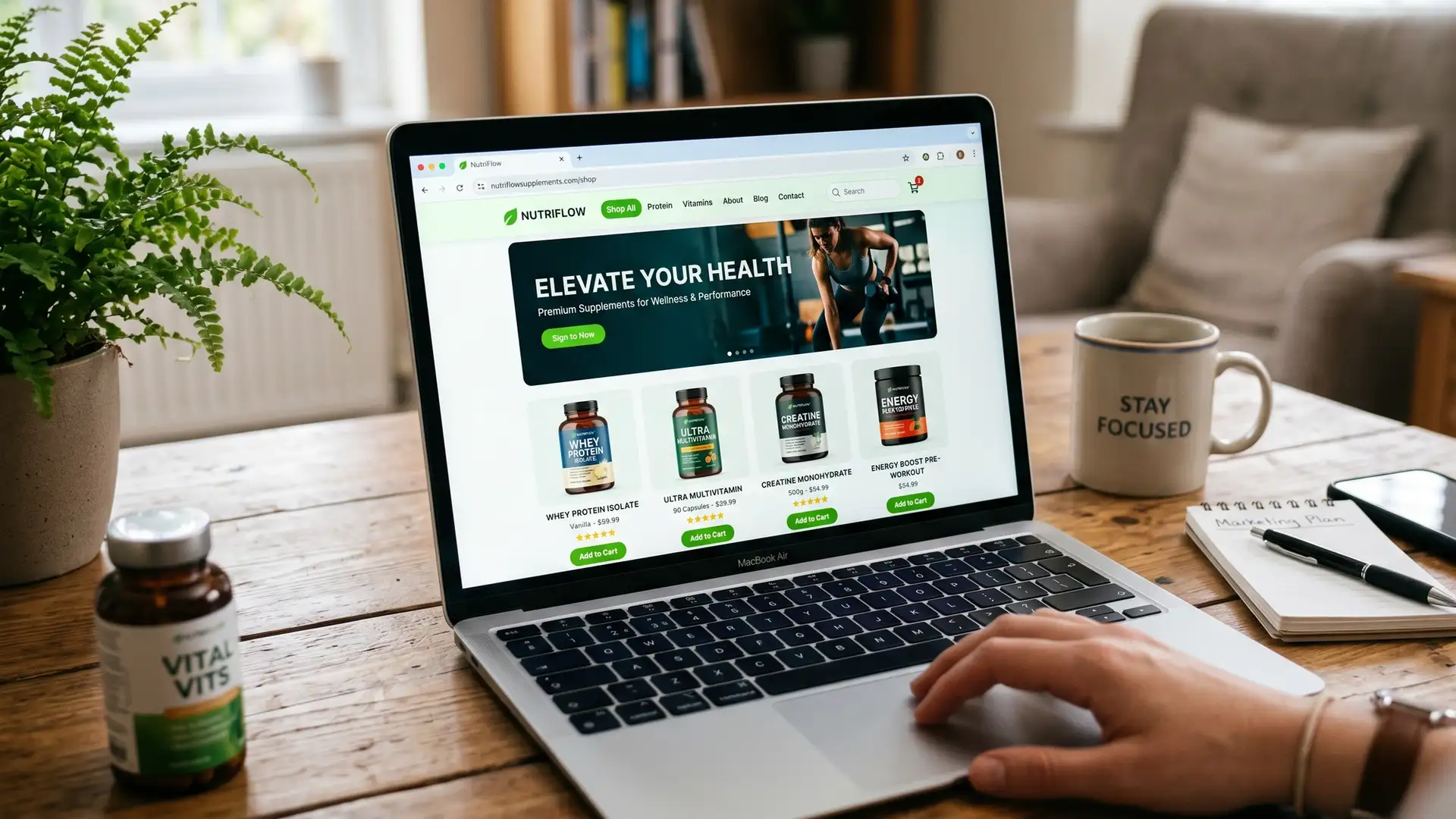
Laptop with an online supplement ecom business in browser
Credit: Adaptiv Payments


Account Executive at Adaptiv Payments | More
Starting your own supplement business online requires more than picking products and developing a website. Early decisions about niche, sourcing, claims, billing, and fulfillment will determine if you have a clean launch or avoidable friction.
In addition to these hard decisions, you should consider payment processing solutions for supplement businesses before launch. The right processor can improve conversion rates and prevent unnecessary losses, helping set your supplement company up for success.
This guide will walk you through the setup process in the correct order so that your online store is ready for launch day and can reach its target audience more easily.
Choose a Niche and Establish Your Brand Identity as the First Step of Your Business Plan
To start selling supplements online, you need to know who wants your products and why. This starts with defining your ideal customer and choosing a category focus that prioritizes their needs.
Niche clarity helps you select the right supplement products to sell, avoiding overextending yourself with low-performing ones. This will also make it easier to develop your supplement branding and structure your store so the best-performing products are front and center.
Avoid a broad "something for everything" positioning, as it makes it harder to build a loyal customer base. You would not be able to segment marketing as effectively, resulting in lower overall satisfaction with your messaging. Additionally, starting with a smaller line of high-quality supplements reduces overhead and lets you scale over time.
One common tactic is to create a target customer who needs your product. For example, you could consider the needs of busy professionals between the ages of 50 and 60. They may want to lose weight, preserve joint health, and keep their immune system strong despite high stress. Their primary product interests would be immune support, collagen, or weight loss supplements.
Once you've assessed who your products are for, you'll need to perform market research into your niche within the supplement industry, including product demand and competition. Assess the target market trends, the average customer lifetime value, and overall sales volume for these specific products.
Pick a Business Model That Fits Your Budget and Control Needs
There are four primary models, each with its own benefits and setbacks. You must choose the right one for your investment budget, launch timeline, and overall needs.
Reselling Existing Brands
This works much like a health food store, where you sell high-quality products from known brands. As the product already exists, there is a short time to launch, but you don't have control over the branding.
The profit margins may also be lower, though the documentation burden is smaller because the original brand performed the testing and batch control. The primary operational issue is inventory management and customer relations.
Private Label
A third-party manufacturer produces supplements from known formulas for your brand. For example, they may produce Vitamin C drops or powders that have your branding on the label. This provides you with significant control over branding. The profit margins will be higher than resale but not as high as contract manufacturing.
However, because the formulas are similar to those of competitors, you must work hard to differentiate yourself. You may also be responsible for third-party testing or required to document the testing process. In this model, you must oversee both customer relationships and a portion of the manufacturing process, adding to operational complexity.
Dropshipping
In this model, you do not have to hold any products in a warehouse. Instead, you forward orders to your supplier, who then ships them to the customer, and you receive a percentage of the profits. The profit margins are low because you might have to pay fulfillment fees, but with effective marketing, you can achieve significant profits. Dropshipping is also quick to launch and does not require significant documentation.
Branding control depends on the supplier. Some will provide labeling, while others don't have this option. Operational complexity here comes from managing customers and communicating with the supplier.
Contract Manufacturing
In this instance, you work with a manufacturer to produce custom products according to your own formulations, including testing and ensuring FDA compliance.
Developing a custom formula takes time and careful research, meaning the documentation burden is high and the time to launch is slow. Operations are more complex as they require an understanding of both manufacturing and marketing.
While contract manufacturing may take the longest to get started, it also offers strong branding potential and high profit margins because you have developed a unique product that can be easily differentiated from others.
| Reselling Existing Brands | Private Label Supplements | Dropshipping | Contract Manufacturing | |
|---|---|---|---|---|
| Startup Cost | Medium | Low | Low | High |
| Speed to Launch | Fast | Medium | Fast | Slow |
| Branding Control | Minimal | Significant control | Some control, but it depends on the supplier | Complete control |
| Margin Potential | Low | Medium | Low | High |
| Documentation Burden | Low | Medium | Low | High |
| Operational Complexity | Low | Medium | Low | High |
While resale and dropshipping are the fastest and easiest to get started, they also have the lowest profit margins. Private labeling requires more upfront capital but offers higher profits and greater branding potential. Contract manufacturing with custom formulations is a significant upfront investment and requires nutritional supplement expertise, but it can also create strong brand loyalty.
Choose a Billing Model for Your Dietary Supplement or Meal Replacement Business
You also need to consider what billing model makes sense for your company. Typically, you can choose between a one-time purchase (OTP) and a subscription model.
One-time purchase models mean that the customer pays for a single shipment at a time. This can enhance customer trust as they don't feel pressured, but it also may cause issues with customer retention if customers forget to return to your store when they're out or decide to shop with a competitor.
OTP models are often best for newer businesses because they are less operationally complex.
The other option is a subscription model, where customers set up billing for repeat purchases and receive the same product at regular intervals. This is a good way to retain customers, but it does add complexity because you will need to manage inventory and set up recurring billing. It also may lead to higher disputes if customers don't recognize the charge. You will need specialized payment processing for subscription businesses, as not all processors are skilled with this.
Another option is a hybrid model. With a hybrid model, customers can choose between a one-time purchase and a subscription, depending on their needs. This makes sense for supplement sales in certain niches, like weight loss, where customers may need long-term and consistent use. It may not work as well for other products, like bulk protein supplements, where customers may use the same product for several months and order when they're out.
The billing model can affect customer expectations in several ways. First, a company that pushes recurring billing but has an unclear cancellation policy may make customers hesitant to sign up, worried that the products do not work quickly. On the other hand, a one-time pricing model may lead customers to believe your products work immediately, resulting in dissatisfaction.
Vet Suppliers Before You Commit to a Product Line
Your supplier affects the product quality, which ultimately affects every aspect of your business. Not only that, but the FDA requires all manufacturers to have Good Manufacturing Practices (GMP) certification. A low-priced supplier may cause legal issues or customer complaints later on.
Request their product and ingredient documentation, then order samples to verify consistency and quality. You'll also want to review packaging quality and shipping reliability to ensure you do not run into inventory bottlenecks.
Before signing contracts, understand who is responsible if there is a formulation, labeling, or fulfillment problem. Have both your and the manufacturer's obligations outlined, and ensure you have a reliable contact in the company who can address any concerns.
Understand the Legal Requirements and Applicable FDA Regulations

A supplement company owner reviewing legal requirements for payment processing
Credit: Adaptiv Payments
There is often confusion around whether you need a license to sell supplements. Most sellers do not need a license, but manufacturers must be licensed.
The FDA regulates supplements but does not approve them before launch. Its primary regulatory role is to ensure that dangerous or defective products do not enter the market, such as supplements containing untested ingredients or products with dangerously high levels of contaminants.
Your sourcing options can affect your risk exposure. Always choose reputable suppliers and manufacturers that provide meticulous product documentation, from batch controls to equipment maintenance.
The FDA prohibits disease or function claims. Most supplements must have a disclaimer that says, "These statements have not been evaluated by the Food and Drug Administration. This product is not intended to diagnose, treat, cure, or prevent disease."
Additionally, your product pages must not claim that your products can treat a specific condition, such as stating that protein will reverse osteoporosis or that Vitamin D prevents the common cold.
As claims can create risk quickly, new sellers should not try to improvise around product rules but instead consult with an expert.
Build the Store Around Clear Product Pages and Visible Policies
Before you begin to sell online, you must develop a site that clearly explains your products and policies. Each site should have these elements:
- Product Pages: Include clear product titles and descriptions, ingredient and serving details, and any allergens.
- Navigation and Product Organization: Use header and footer bars that allow access to the most important pages. Implement a search tool so customers can find products quickly.
- FAQ: Answer common questions like common side effects, contraindicated uses, and how to use.
- Shipping, Return, and Refund Pages: Explain your shipping, return, and refund policies before customers check out.
- Contact Information: In addition to an email address and contact form, you may use a chatbot.
- Trust Signals: Certifications, testimonials,
Consider Operations to Maximize Customer Satisfaction
First, you must determine the shipping process, such as whether you're using a third-party logistics company. This is usually faster and places less operational burden on your team.
Set realistic delivery windows rather than stating you provide next-day shipping. Shipment tracking and proof of delivery can reduce disputes. Decide in advance what proof is necessary before refunding damaged, delayed, or lost orders, such as waiting 5 days after the delivery window or requiring proof of damage.
Provide multiple support channels, such as phone, text, email, and chat. Train your customer service representatives on common pre-purchase and post-purchase questions, like how to use delivery tracking and where to send returns.
Choose an Ecommerce Platform
The best option for nutritional supplements is to open your own online store with an integrated payment gateway. This way, you have full control over each aspect of customer communications and product messaging. You also do not have to worry about abrupt changes to the terms of service.
While many supplement companies use Amazon, BigCommerce, WooCommerce, or Shopify as a platform for selling supplements online, they may require additional documentation like COAs and testing. Always check the platform's terms of service and consider using a high-risk payment processor to avoid account limitations.
Set Up Payments
Not every processor treats supplement stores the same way. While clear policies and strong product pages can help, your model, claims, billing structure, and fulfillment practices may determine merchant account approval for nutraceutical products.
Payment planning is easier before launch, as it prevents you from having to troubleshoot. Explore your options and compare pricing structures before committing.
Set Up Customer Acquisition Channels
Social media marketing is one of the most high-performing digital marketing strategies, as it allows you to provide valuable content directly to interested customers. Most social media platforms enable paid advertising with product images and testimonials.
When developing marketing materials, focus on credibility and product quality. For example, if you have independent research into your products, prioritize this and explain what the lab results mean. Discuss your sourcing process and why you use superior ingredients compared to competitors.
Email marketing is a powerful way to retain customers. Consider the customer's journey with your product and send regular updates, including any promotions or referral links.
Testimonials, especially those from named customers with photos, are extremely valuable, as they replicate word-of-mouth marketing. Ensure your advertisements comply with FTC regulations and do not make any disease claims.
How Adaptiv Payments Can Help You Make Money Selling Supplements Online
Adaptiv Payments offers payment processing solutions for businesses considered high-risk. Our thorough underwriting process ensures that we fully understand your operational model and can provide personalized solutions for your company's specific needs.
When underwriting, we review the following information:
- Business formation documents
- Average order value
- Website, including product pages with ingredient and usage information
- Product claims and compliance
- Clear shipping, refund, and support policies
- Subscription disclosures
- Supplier or manufacturer credibility and certification
- Fulfillment and customer support operations
- Customer service process
- Clear billing descriptions and transaction records
This thorough review ensures we fully understand every aspect of your business, including essential services such as fraud protection and chargeback mitigation. The underwriting process also means you can enjoy uninterrupted access to account services, which is a common problem for supplement businesses that use payment service aggregators.
