How to Get an FFL License
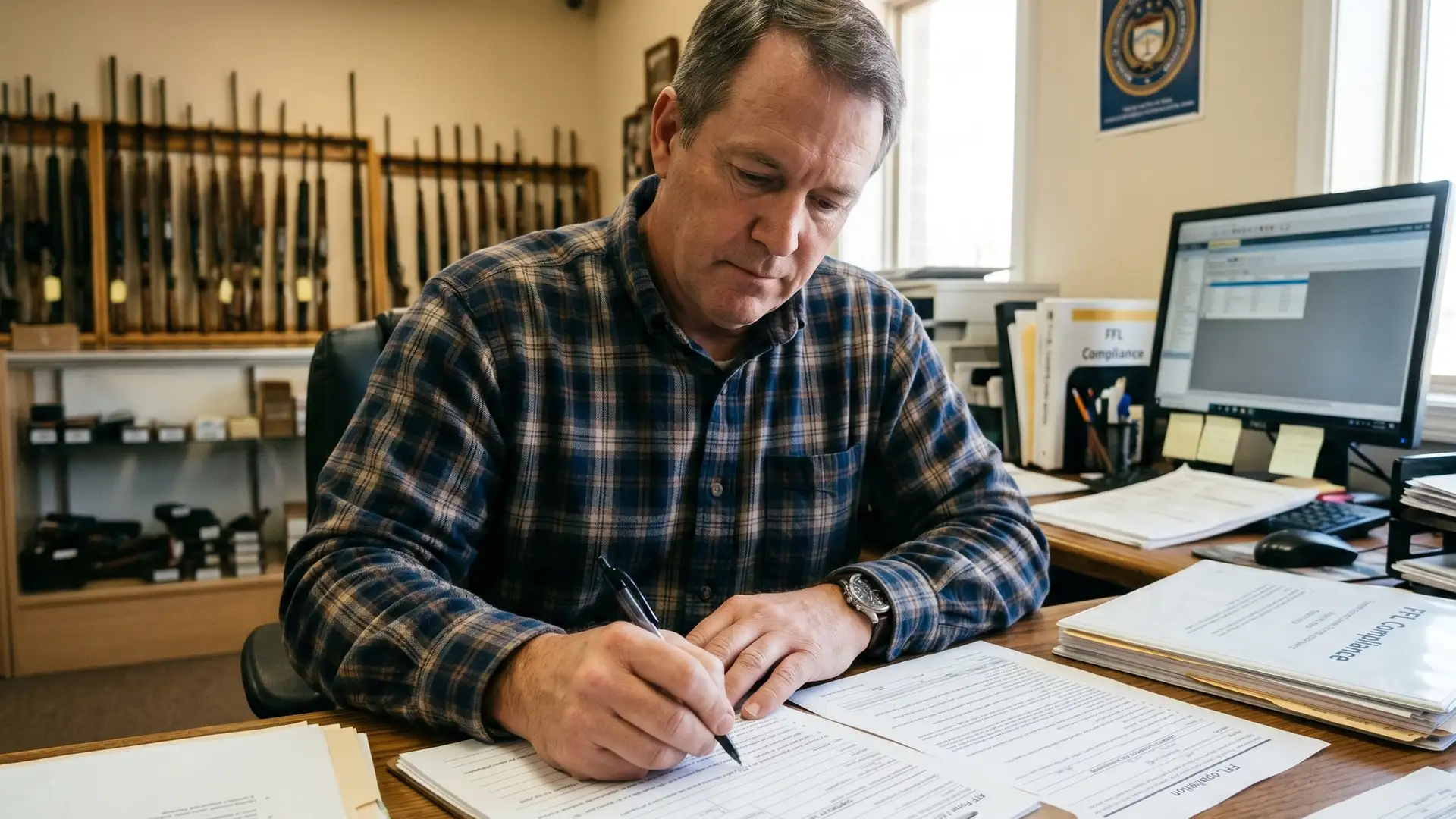
A man in a firearm shop filling out an FFL application
Credit: Adaptiv Payments


Tech Lead at Adaptiv Payments | More
Getting an FFL license requires an application, compliance inspection, and interview on your premises. There are different FFL licenses, depending on your business model, making it crucial to select the right one for your needs. To keep your license, you must maintain Bureau of Alcohol, Tobacco, and Firearms (ATF) compliance and follow any local laws relevant to your operations.
What Is a Federal Firearms License and Who Needs One?
A Federal Firearms License is a license issued by the Bureau of Alcohol, Tobacco, and Firearms in accordance with the Gun Control Act of 1968. Anyone who manufactures, imports, or deals firearms for profit is required to have this license.
FFL Types
There are several types of FFL licenses, meaning you must choose the right one for your business needs. These are the common FFL types and their typical use cases:
- Type 01: Firearms dealers for standard weapons like short-barreled rifles, including gunsmiths
- Type 02: Pawnbrokers that accept firearms as collateral
- Type 03: Selling curios and relics for collectors, like muskets
- Type 06: Ammunition manufacturing for standard firearms like rifles and shotguns
- Type 07: Manufacturing standard firearms, like rifles and handguns
- Type 08: Importing ammunition or firearms
- Type 09: Dealer in destructive devices, like bombs and grenades
- Type 10: Manufacturing destructive devices or military-grade weaponry, like machine guns or armor-piercing ammunition
- Type 11: Importing destructive devices or military-grade weaponry
- Type 12: Manufacturing standard firearms for foreign markets, not for sale in the United States
- Type 13: Ammunition manufacturing for foreign markets, not for sale in the United States
Those collecting weapons for personal use may need a concealed carry permit, but they do not need an FFL dealer's license.
FFL License Eligibility Requirements
To get a Federal Firearms License, you must be a US citizen or permanent resident who is at least 21 years old. You also must not be prohibited from owning firearms, meaning no felony convictions or violent offenses. Marijuana use can also prohibit someone from getting an FFL, even if it is legal in their state.
Your property must be zoned for commercial firearm activity, whether you are an importer, manufacturer, or dealer. Additionally, your premises must comply with security standards, such as firearms locks and gun safes.
Can You Get an FFL Without a Business?
It is possible to obtain home-based FFLs, such as for curio and relic collectors or gunsmithing. However, you will still need a legitimate business premises. This building should be properly zoned for your intent.
What Is a Special Occupational Taxpayer (SOT) Class?
A Special Occupational Taxpayer (SOT) is an FFL holder who needs to file an annual tax to the ATF for certain types of firearms, like NFA firearms. There are three classes depending on whether the taxpayer is importing, manufacturing, or selling firearms that are regulated by the National Firearms Act.
SOT is not required to become an FFL firearms dealer, unless you manufacture, import, or sell firearms like machine guns or silencers.
The FFL Application Process
The firearms industry is tightly regulated at the local and federal levels. First, you must demonstrate intent to conduct business by establishing a corporation, securing property, and obtaining an Employer Identification Number (EIN) from the IRS. Private owners do not need to possess an FFL. Only those who intend to manufacture, deal, import, or export firearms or ammunition do.
Once this is done, you will fill out ATF Form 7/7CR, which applies to all license types, but there are some exceptions for those who deal in curios or relics.
Everyone with ownership in the business, or who can make business decisions, must be included in the application. You will need to provide a recent picture and a fingerprint card for each person on the application. You will then mail the completed application to the address on your application.
Ensure you include the correct application fee for your FFL type, which can range from $200 for a firearm dealer to $3,000 for a manufacturer or dealer of destructive devices.
Background Check of the Responsible Person
After the ATF receives your application, it will conduct an electronic background check of the responsible person or persons. This ensures that you do not have any felonies that would prevent you from possessing a firearm. If you pass the check, then your application will be sent to the local ATF field office to schedule an interview and inspection.
Interview and Inspection
You will need to undergo an in-person interview and premises inspection with an Industry Operations Investigator (IOI) from the local field office.
The IOI will discuss federal, state, and local laws and review your application with you to ensure everything remains up to date.
Next, the IOI will inspect your building to ensure it is properly zoned and that you have all necessary security measures in place, such as lockboxes for firearms and gun locks. They will then let you know if you are approved or denied and explain the next steps, including when you will receive your license and can begin making sales.
Payment and Approval
If you are approved, then your application fee is credited to your initial three-year license. After that, you will need to pay a renewal fee to remain in compliance.
The IOI may also explain why you were denied, such as not being properly zoned, applying for the wrong license, or not passing the background check.
Ongoing Compliance After You Get Your FFL

A laptop with an online checkout for firearms open on checkout screen.
Credit: Adaptiv Payments
Once you have received your FFL, you must maintain compliance through thorough recordkeeping and regular audits. Ensure you keep records of all sales and transfers, called the A&D book, and make corrections if information is missing. You should perform an NCIS check on all potential buyers. All weapons must be kept secure at all times with locks.
Transferring ownership of a firearm requires you to fill out multiple forms and perform a background check on the recipient. You also must keep these records, including failed transfers, to comply with federal and local regulations.
ATF officers may come to perform on-site inspections. This can include checking your records for the past 12 months and ensuring that all firearms on the premises, excluding personal weapons, are accounted for. This process may take several days, and you will also need to undergo an exit interview where the IOI officer discusses any potential violations.
Firearms businesses are typically classified as high-risk due to the nature of the industry, meaning they require specialized high-risk merchant accounts and processors. However, failing to comply with federal and local standards can impact your payment processing and account standing.
Payments for Firearms Businesses
Standard payment processors typically do not work with firearms because of the high risk. For example, new dealers consider PayPal as an option for gun payments without realizing that PayPal does not allow arms deals. The industry is strictly regulated, and fraud is unfortunately common.
Mainstream payment processors may also decline your payments or hold reserves because of the risk of chargebacks or fraud. You can avoid this by seeking out a specialized firearms merchant account, which is designed for dealers and manufacturers.
These payment systems combine payment gateways, payment processors, and merchant accounts into one stacked system. Payment processors like Adaptiv Payments also provide virtual terminal merchant accounts that enable card-not-present transactions and online sales.
When choosing a payment processor, you will need to provide business documentation, such as your FFL license, business plan, tax ID, and bank statements. Processors may also ask for information about your security standards and transfer processes.
The processor will also want to know that you have clear policies around cancellations, refunds, shipping, and disputes. This is crucial for customer satisfaction and chargeback prevention.
A quality merchant account will offer strong fraud protection, including real-time fraud monitoring and enhanced authentication for high-risk transactions. Apaptiv offers chargeback mitigation tools to help you proactively manage disputes, as well as tools like multiple currencies if you also export firearms.
FAQs
While the ATF website states that it typically takes 60 days, timelines can vary depending on factors such as whether there were issues with your
You can get an FFL at your home address if your property is zoned for home-based businesses. You may also need to get HOA or condo association approval.
To start an online gun store, you would need a Type 01 FFL, which allows for firearm transfers and shipping.
To sell firearms legally, you will need local zoning approval. Typically, this means that you are not within a certain distance of sensitive installations like schools, playgrounds, libraries, and churches. You may wish to speak to your local zoning council before purchasing a property or applying for a license.
There are several common reasons firearms merchant accounts are declined, which include strict federal and local requirements, high risk of fraud or theft, and potential reputational risk.
The safest way to set up payment processing for high-risk industries is to work with a payment processor that understands your industry's requirements. Traditional financial institutions and mainstream processors like PayPal do not work with firearms sales due to the high risk of fraud, theft, or chargeback disputes.
